Blue Headed Macaw Habitat and Field Notes from Manu Park

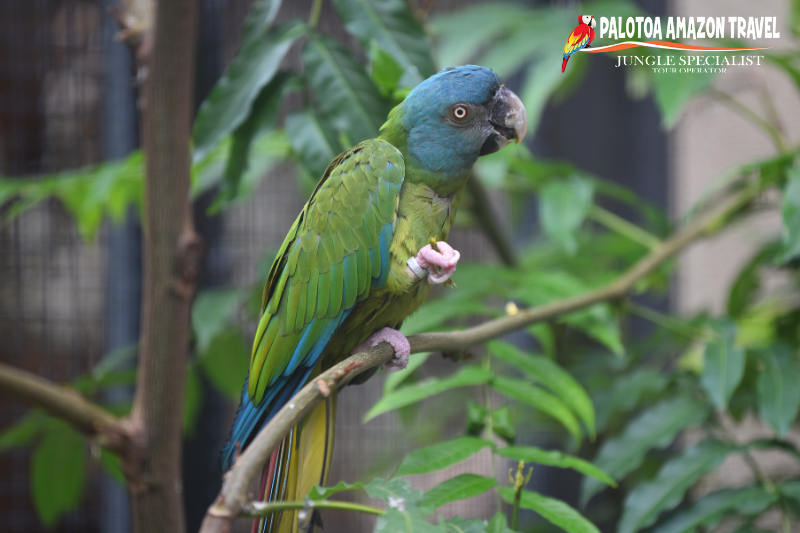
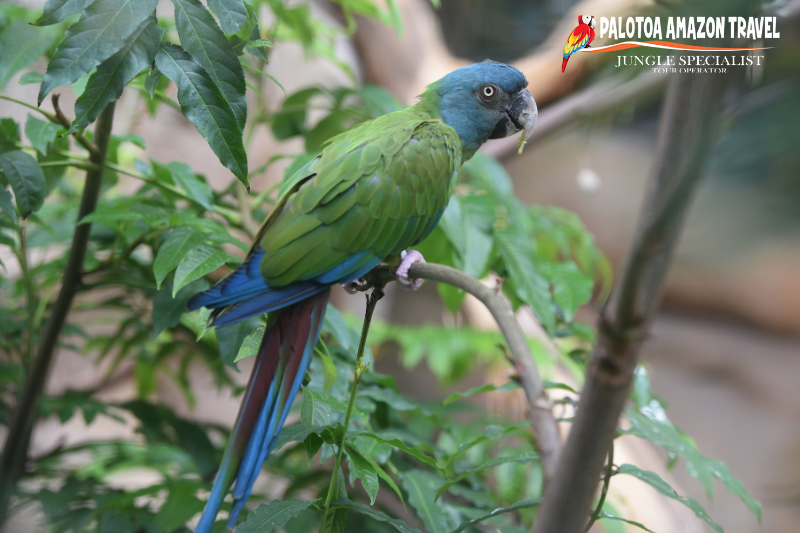
The Peruvian Blue-Headed Macaw (Primolius couloni), or the blue headed macaw, is a forest dwelling, silent parrot, with mostly green feathers and a cobalt-blue head. Dubbed a “mini-macaw“, it is smaller and less noisy than the larger macaws found in the Amazon. Historical accounts show that in Peru, the species primarily inhabits intact transitional forests between the lowland rainforest and the foothills of the Andean Nazca and Carabaya Ranges. This ecological transition zone influences what the bird eats, where it nests, and how it uses its time.

Blue Headed Macaw

Where the Rainforest Climbs the Mountains: Peru’s Andean-Amazonian Foothills

The blue-headed bird lives not only in flat, lowland rainforest but also favors transitional forests, where lowland rainforest meets the foothills of the Andes. In Peru, ridges, slopes, and river valleys create complex habitats, offering canopy trees for travel and foraging, mid-level foliage for cover, and cooler temperatures than the lowlands.

Within this habitat, the species typically occupies low to intermediate elevations, ranging from 500 to 4,900 feet (150 to 1,500 meters). These pockets of altitude contain a suite of suitable food plants and nest sites, as well as migration routes along rivers and edges of forested hillsides.

For many birders, the first choice for birding Peru to find this species is in our protected forest in southern Peru – in particular, within and around Manu Park (Manu National Park), celebrated for its diversity and gradual altitude and ecosystem changes from rainforest to cloud forest. This is important: different foods are brought together within a short distance, and provides several layers of habitat through which a stealthy macaw can hide.

Recognizing the Blue Headed Parrot in the Canopy

Visibility in foothill forests of Peru is constrained by elevation, vegetation and distance. Perched, the green body can obscure the individual in leafy foliage, with the most distinctive feature being the blue crown when illuminated. During flight the overall appearance is of a small macaw with fast, direct wingbeats, commonly flying over mid-canopy openings, or along river edges.

The species can be less vocal than other macaws, so it requires careful scanning and listening for faint calls amid the dawn chorus. Finding success is often more of a perseverance game: reviewing the same fruiting trees, flight patterns and riverbank look-out points over several days.

Riverbank Clay Licks in Peru: A Critical Daily Resource

Blue Headed Macaw

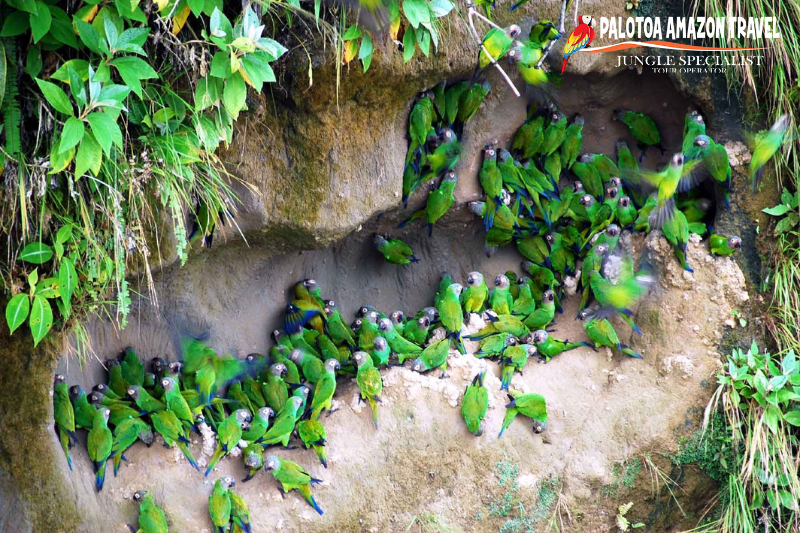
Across the Amazonian foothill forests of Peru, parrots gather at open riverbanks to eat mineral-rich clay, a behavior known as geophagy. Clay licks provide a type of “mineral bar” to blue headed macaws, allowing individuals to supplement and regulate minerals and compounds in some fruits and seeds.

Risk of predation also affects the use of clay licks. Groups of parrots may spend some time flying overhead before landing. Some paranoid individuals may wait until other species of parrots have landed first so as to make use of the group as a sentinel before alighting on land. This makes the species seem scarce, even in habitats where it is found.

Clay lick tours in Manu Park: What Responsible Viewing Looks Like

For people interested in Clay lick tours, Manu Park and other protected forests throughout Peru offer the most structured opportunities to see parrots at clay licks. Responsible tours focus on maintaining distance, hiding and arriving at times of day that would not force the birds to leave their food source before their breakfasts. Observation focuses on observing natural behaviour, such as approach patterns, flock dynamics and feeding.

For birders, clay licks are also a site of learning: the first time I visited, it was windy and the river was low, and birds were active until late in the morning. If a group remains in the canopy of the trees close to you, and does not move down, it may be wise to keep quiet and wait.

Feeding, Movement, and Nesting in Peru’s Foothill Forests

The majority of a bird’s daily life is spent traversing the forest’s canopy and mid-canopy for seasonal food. As with many other parrots it has a diverse diet of fruits, seeds, and other vegetation, and can change foraging patterns with the seasons as trees bear fruit. In the ecotonal forest, this seasonality can be extreme at very steep elevations, so pairs may have several foraging areas within their territory.

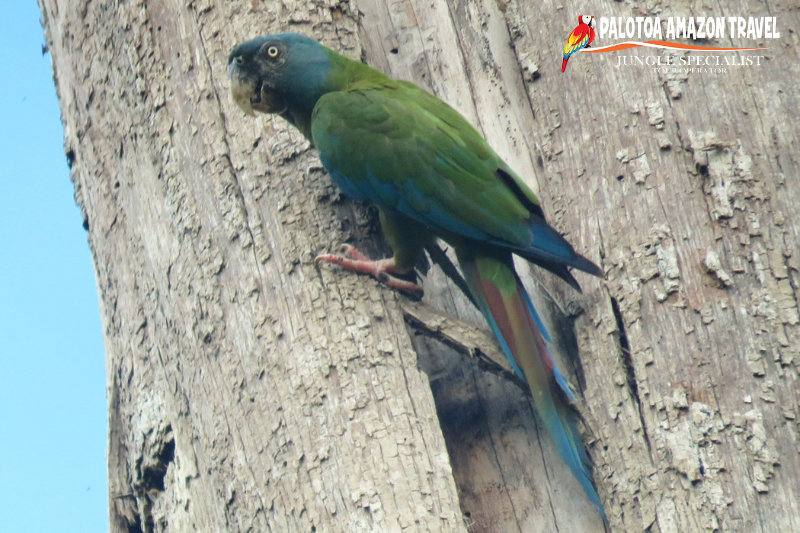
We’ve also seen pairs that spend a lot of time together, a common bonding feature of many macaws. Most commonly, breeding occurs in tree holes, typically in old or dead palms or large trees with appropriate cavities. With limited suitable used cavities in any forest, nesting success depends in part on the presence of large trees. In Peru this is one of the reasons why forests with good structure (not just trees) are important: they are more likely to have trees suitable for use as cavities.

Blue Headed Macaw

Birdwatching strategy in Peru: Increasing your chances without pushing the birds

Birdwatching for this species in Peru is often a matter of discipline. The best times are in the early morning, at rivers, gaps in the canopy and along clay licks (where known). Longer stints in place can be more productive than moving around because the blue headed parrot will return to a feeding tree after some time.

Low-impact zone practices also maintain natural conditions:

  • Keep voices low and movements slow at canopy viewpoints and riverbanks.
  • Be quiet and move slowly around canopy viewpoints and waterways.
  • Don’t play calls around suspected nests, where it can have especially large impacts.
  • Make good use of optics, keep an eye out on the top canopy level, then lower down, then scan again.

Conservation Focus in Peru: Keeping Habitat Intact

The best way ecotourists can help this species is to ensure the preservation of the forest ecosystems it relies on: unwalled foothill rainforest, intact nesting cavities and river corridors that support clay licks and plants and trees. Sustainable ecotourism and credible conservation groups in Peru can help ensure the continued protection of places like Manu National Park and other key locations in the future.

Blue Headed Macaw

In a practical sense, conservation is all about continuity. By keeping forests connected (surrounded by rivers, on the slopes, with mature canopy cover) the landscape provides future food trees, nest holes and travel corridors. By maintaining habitat in Peru—particularly the transitional forests between lowland rainforest and the Andean slopes—conservation efforts can ensure that visitors continue to enjoy the blue-headed macaw in this highly diverse region for years to come.

Q&A

Where in Peru is the Blue-headed Macaw most likely to be found, and at what elevations?

It is closely linked to transitional forests, where Amazonian lowland rainforest borders the Andean foothills. In Peru, the species commonly occurs from near sea level up to about 4,900 feet (1,500 meters). This landscape of hills, ridges and river systems offers structural diversity and travel pathways along streams and forest edges.

Why do Blue-headed Macaws visit riverbank clay licks?

Clay licks provide minerals to balance dietary mineral intake, but also to counter the possible compound effects of some seeds and unripe fruit (often called “geophagy”). To avoid predation, flocks may circle and call and wait for other species to disembark before they arrive to perch and feed.

What role do Clay lick tours play for birding in Manu Park?

Responsible Clay lick tours can allow tourists to view parrots without “canoeing” around the forest looking for good feeding sources. Tour operators can keep their distance to minimise disturbance and you might witness natural approach and feeding patterns.

Why is it called a “mini-macaw,” and how does it differ from larger macaws?

The Blue-headed Macaw is smaller and quieter than most big, noisy Amazonian macaws, thus earning it the title of “mini-macaw”. It’s a shy, arboreal species with generally green feathers and a sky-blue head.

How does the Blue-headed Macaw feed, move, and nest in foothill forests?

It spends its days flitting through the canopy and mid-canopy in search of fruiting and seeding trees. This species shows a high degree of partner fidelity. For nesting, it uses tree holes—typically in old, dead palms or other large trees—and depends on mature forests where such cavities are available.

What are the most effective conservation actions for this species in Peru?

Preserving undisturbed foothill rainforest, conserving older nesting trees and preserving river corridors that support clay licks is a priority. Sustainable ecotourism and support for conservation initiatives – particularly in and around Manu National Park – also protect the forest transition areas its habitat includes.

Leave a Reply

This website uses cookies to improve your experience.