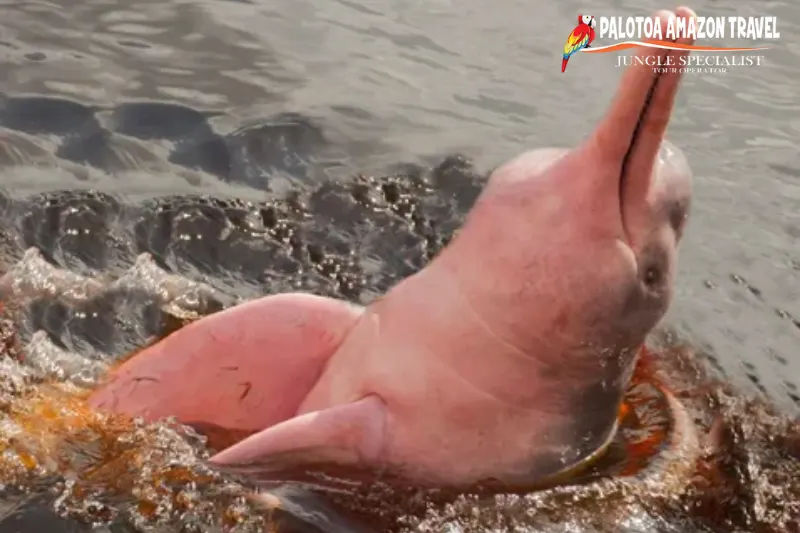
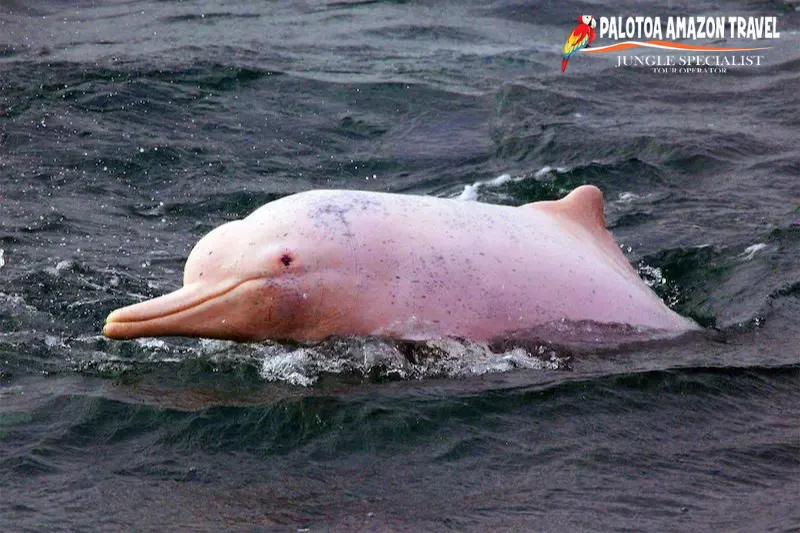
You’re on a boat somewhere between Iquitos and nowhere, the water is the color of old tea, trees on both sides so thick you can’t see ten feet into them, and then something pink rolls up next to the hull. Not gray. Pink. Like someone colored it wrong. Nobody on the boat says anything for a second because nobody quite believes it.
Most people find out these animals exist the moment they see one. That’s actually one of the fun facts about amazon wildlife that guides love to lead with: half the visitors on any given river trip had no idea pink dolphins were real until that morning.
Why are pink dolphins here and not in an ocean somewhere is the question that follows, and the answer is genuinely strange. These are not river animals that wandered in from the coast. They are ocean animals that got geologically trapped here millions of years ago and had no choice but to change or disappear. They changed. Radically.

The color thing trips people up because the calves come out completely gray. Nothing special, nothing that would catch your eye. The pink develops slowly over years and the mechanism behind it is stranger than most people expect.
Part of it is just blood flow. Pink river dolphins have circulation close enough to the skin surface that you can watch it change in real time. Warm river water means the body constantly pushes blood outward to cool down, and when the animal is excited or chasing something that flush gets noticeably more intense. The color you’re seeing is literally the animal’s temperature regulation showing through its skin.
The rest is wear. These dolphins spend their lives pushing through submerged branches, root tangles, and tight underwater spaces, and that constant contact gradually strips the gray outer skin layer away. Males fight each other over females and territory, biting and ramming, and every healed wound exposes more pink tissue underneath. The oldest males with the most history on them tend to glow the most intensely. That’s one of those river dolphin facts that changes how you look at them once you know it.
Fifteen million years ago a shallow saltwater sea sat over a massive chunk of South America. Real ocean water covering what is now Peru, Bolivia, and Brazil. Dolphins lived in it like any coastal population anywhere else.
The Andes came up. Tectonic movement pushed that mountain range along the western edge of the continent and cut the inland sea off from the Pacific. Over millions of years the trapped water freshened from rainfall and mountain runoff until the salt was gone and what remained became the Amazon basin. That’s one of those 10 incredible facts about amazon geography that genuinely reframes the whole region once it lands.
The dolphins already inside when that happened either adapted or died. They adapted, over an almost incomprehensible stretch of time, into something so different from their ocean relatives that scientists sometimes describe them as a living fossil. They held onto physical features that other dolphin lineages dropped long ago because those features turned out to be exactly what a flooded jungle requires.

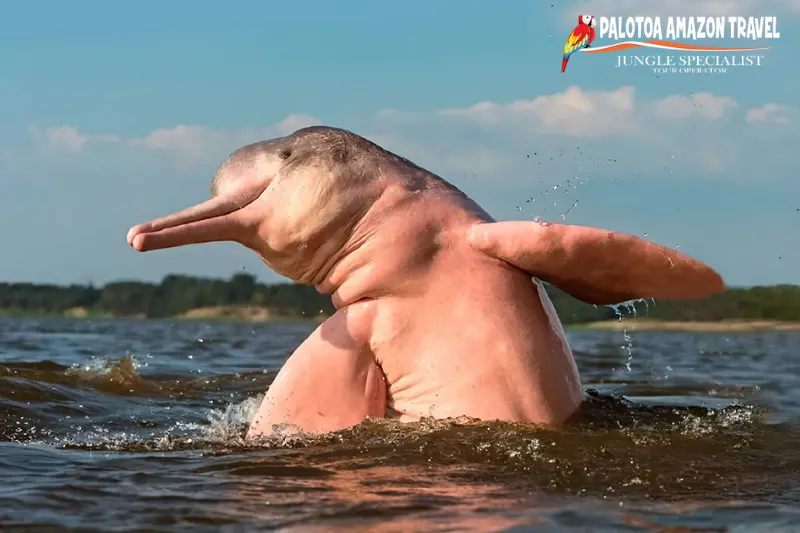
Ocean dolphins are streamlined, fast, built for open water and straight-line chasing. That body would be useless in a flooded forest full of tree trunks, shallow mud, and root systems going in every direction. The Boto went a completely different way.
The neck is the most striking difference. Most dolphins have fused vertebrae in the neck and literally cannot turn their heads. The whole body has to swing to change direction. Amazon pink dolphins never fused those bones, so the head rotates about 90 degrees and the snout can point straight down into the mud to dig out fish that no ocean dolphin could ever reach.
The dorsal fin reduced to a low flat ridge so it doesn’t catch on branches mid-swim. The front flippers went wide and paddle-shaped, sacrificing speed for the ability to reverse, pivot tight, and push through spaces barely big enough to fit through. In open ocean that whole design is a liability. Inside the pink dolphins habitat it works exactly as needed.
First-timers usually assume every dolphin they spot is the pink one. Then a small gray animal launches completely clear of the water in a clean arc and someone has to explain that’s actually a different species entirely. The Tucuxi shares the same rivers but has almost nothing else in common with the Boto beyond both being dolphins.
Color is the obvious starting point. The Boto turns pink, sometimes very pink depending on the individual and age, while the Tucuxi stays gray its whole life without exception. The fins read differently too. Tucuxi carries a tall triangular fin, the classic dolphin shape most people picture, while the Boto has that low flat hump along the back.
Jumping settles it fast. Tucuxis leap because they’re built for speed in open channels. Botos almost never clear the surface because in flooded forest understory jumping means hitting a tree. If something comes fully out of the water and lands with a big splash, that’s your Tucuxi. Both count as amazon river fauna but they occupy completely separate ecological roles in the same water system.

Communities along the Peruvian Amazon will tell you the pink dolphin isn’t always a dolphin. The story goes that at night it becomes a man, well-dressed, charming, always wearing a hat pulled low to hide the blowhole on top of his head. He shows up at riverside parties, dances, and vanishes before sunrise. The specifics shift from village to village but the core stays the same across thousands of miles of river.
That story worked as conservation for generations. Hunting the Boto felt spiritually dangerous in a way that carried more weight than any government rule in those communities. Fishermen who accidentally caught one in a net cut the net loose rather than deal with what might follow from keeping it. Folklore protected a population in places where enforcement never went.
Mercury from illegal gold mining changed the equation. Younger generations along the river don’t carry those old stories the same way, and even if they did, contamination moving downstream from mining operations upstream has nothing to do with local belief systems. The threat evolved and the folklore didn’t move with it.
Illegal gold mining along Amazon tributaries uses liquid mercury to pull raw gold from river sediment. That mercury enters the water, gets absorbed by the smallest organisms, moves into the fish eating them, concentrates again in the larger fish eating those, and by the time it reaches the top of the food chain the levels are nowhere near what originally went in.
Amazon pink dolphins sit at the very top and eat large fish every day for decades with nothing predating them. Accumulated mercury never resets. Researchers testing Boto tissue have found concentrations that would register as dangerous in human blood work. Lower birth rates and compromised immune function are already documented in populations near active mining areas.
The reason scientists track this beyond concern for the dolphins themselves is that the Boto works as an indicator species for the whole river. When their health drops it means the same water surrounding communities drink and fish from is carrying the same load. The families eating fish from those channels are absorbing mercury through the exact same food chain, just a few steps below where the Boto sits. What’s happening to the dolphin right now is a preview. Safety in the amazon for both wildlife and the people living alongside it connects directly to what’s happening in those mining operations upstream.

Amazon rainforest seasons shape everything about dolphin visibility. During the wet season the river floods across the jungle floor and spreads dolphins over an enormous area that’s nearly impossible to work. The best time to visit amazon wildlife, dolphins specifically, is May through August when water drops back and fish get pushed into the main channels, bringing everything with them into a much smaller, workable area.
Iquitos is the starting point for most trips. Biggest city in the Peruvian Amazon, no road connection to the rest of the country, everything moves by river or air. Pacaya Samiria national reserve draws the serious wildlife watchers, clean blackwater, protected, consistent dolphin activity through the right months. The animals lives in the amazon river here include far more than dolphins. Giant river otters, black caimans, arapaima, multiple turtle species, and hundreds of bird species share that same water system.
Manu national Park further south is harder to reach and that difficulty is part of what makes it feel genuine. Every sighting there feels found rather than arranged.
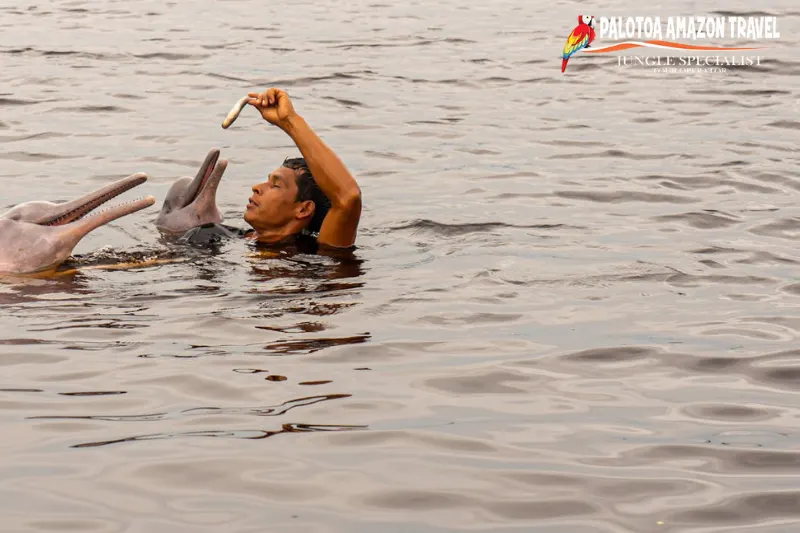
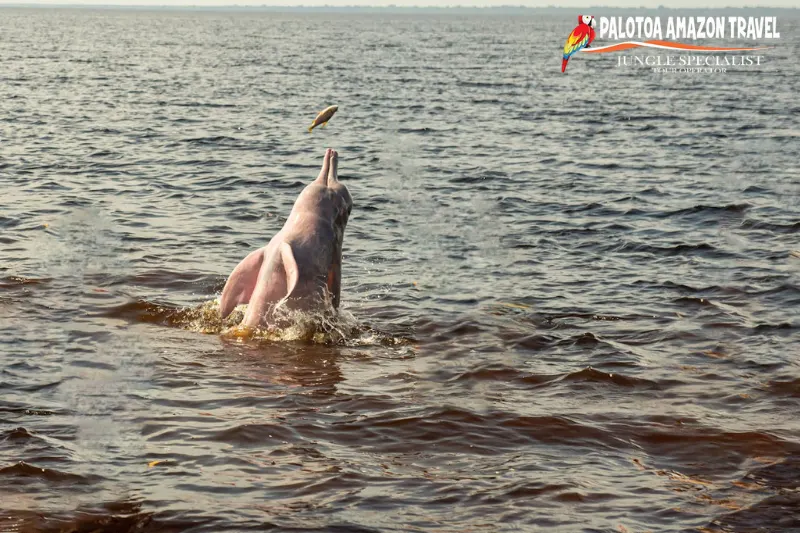
Don’t swim with them. Don’t feed them. Some operators offer both and they shouldn’t. The real encounters happen when the engine cuts, everyone goes quiet, and a Boto surfaces next to the boat because it decided on its own that you were worth checking out.
The Boto has been adapting to this river system for fifteen million years and the biggest threat to its survival showed up in the last fifty. Mercury, boat traffic, habitat loss. Recent problems for an ancient animal.
Keeping the pink dolphins habitat intact connects to decisions made nowhere near the river. Which tour operators get the bookings, where gold in consumer products comes from, how seafood gets sourced. Communities earning real income from responsible wildlife tourism have a practical reason to protect the riverbanks that no awareness campaign alone can replicate.
Seeing one surface next to the boat, unhurried and pink and completely unbothered, means the river is still working. That is not something to take for granted right now and it gets less guaranteed every year.

A saltwater sea covered much of South America millions of years ago and dolphins lived in it. The Andes rose and cut that sea off from the Pacific. The water freshened over millions of years into the Amazon basin, leaving those dolphins stranded inland. They adapted into the Boto rather than dying out.
Calves are born gray. Color builds over years through blood vessels close to the skin surface that flush visibly during activity, plus physical wear from moving through submerged vegetation. Males fight more and carry more scarring, which is why they tend to be the most intensely colored.
Their neck vertebrae never fused so they can turn their heads about 90 degrees and dig fish from riverbed mud. The dorsal fin reduced to avoid snagging branches and the wide paddle-shaped flippers allow tight turns and reverse movement through cramped spaces.
Botos turn pink with age, Tucuxis stay gray. Botos have a low flat ridge on the back, Tucuxis have a tall triangular fin. Tucuxis jump fully out of the water, Botos almost never do.
Mercury from illegal gold mining is the primary threat, accumulating to dangerous levels through the food chain. Best sightings happen May through August from Iquitos, Pacaya Samiria, or Manu Park. No swimming, no feeding, no contact.